
Vol. 09: Lily Learns a Lesson in DC
My unhinged Taiwanese American historical doll fan fiction series continues.

Suggested pre-reading: Vol 05: Meet Lily, A (Taiwanese) American Girl
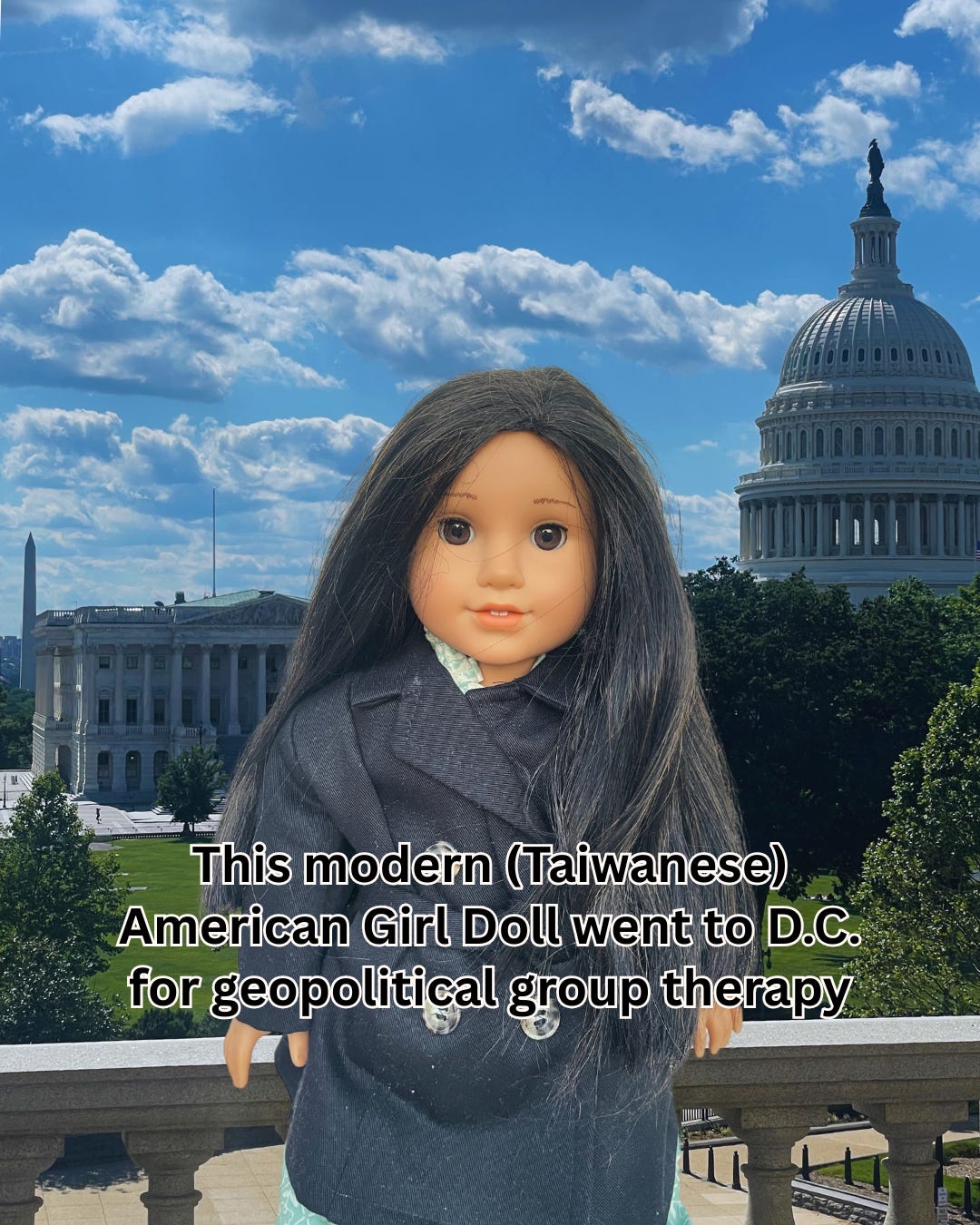
For those still unfamiliar with the American Girl canon, the original historical series each includes an installment in which the American Girl “learns a lesson.” Examples of lessons learned, from the American Girl Wiki:
In 1934 Kit finds that she has hard lessons to learn about the Depression both at home, where she is helping her mother run a boarding house while her father looks for a new job, and at school, where a fight spoils the preparations for the Thanksgiving pageant.
When nine-year-old Nellie begins to attend school, Samantha determines to help her with her schoolwork and learns a great deal herself about what it is like to be a poor child and work in a factory.
Well— in my fan fiction, Lily, a (Taiwanese) American Girl learns a lesson about cross-strait conflict engagement when she steps beyond the borders of her elders’ ideologies towards a geopolitical praxis that is all her own. In true AG style, this lesson is as much about historical trauma as it is about 🌈 friendship 🌈.
All of this is to say: I’m writing from the other side of Strait Talk—a workshop I referenced in Volume 05 and ultimately attended last month—where I got to yap IRL in geopolitical group therapy. In short, it was magnificent and I hope I always hold this experience close to my heart during waves of cynicism and despair.
From the website: Strait Talk is a non-partisan dialogue workshop that empowers young people from both sides of the Taiwan Strait to collaborate in transforming the Taiwan Strait conflict. It is the world’s first initiative that enables direct dialogue on politics and identity between youth from both sides of the Taiwan Strait with the goal of moving toward peace and understanding.
This experience helped me crystalize a few shifts in thinking:
1 - Though collective memories can be restorative, they can also be selective, and thus profoundly harmful. I’ve long pointed to historical fiction as a tool for empathy, but I am coming to terms with how it can equally be manipulated to mischaracterize, flatten, and absolve one group of people at the expense of another. Stories do this all the time, casting heroes and villains in ways that reinforce power rather than question it. Just because a narrative moves or transforms us doesn’t mean it is fundamentally good—or even neutral. We are changed, for better or worse, all the time.
In the topical context of Taiwanese literature, the tensions between waishengren and benshengren narratives make this especially clear. Writers like Lung Ying-tai are celebrated for their lyricism and moral appeals, but the readers in my community have also observed how their works sentimentalize waishengren experiences while sidelining— and sometimes even erasing— the histories of violence, repression, and displacement endured by benshengren and Indigenous communities during the White Terror and Martial Law. The emotional gravity of these stories can lull us into thinking they are balanced, when in truth they may obscure deeply entrenched asymmetries of power and responsibility.
And that’s just the storytelling! The acts of listening and reading— where to begin? How often are even sacred texts selectively chosen to justify fanaticism, brutality, hatred? How often are some narratives uplifted and cherished to obscure others? How often have beautiful stories permitted disaster?
None of this means we must abandon storytelling— we must do more of it! But with greater care, and greater scrutiny as readers and writers. Who is being remembered, and who is being forgotten? Whose pain is made poetic, and whose is made invisible? If stories have the power to shape memory, then we must take seriously the ethical work of shaping stories—especially when they move us. Especially when they comfort us. Especially when they ask us to look away.
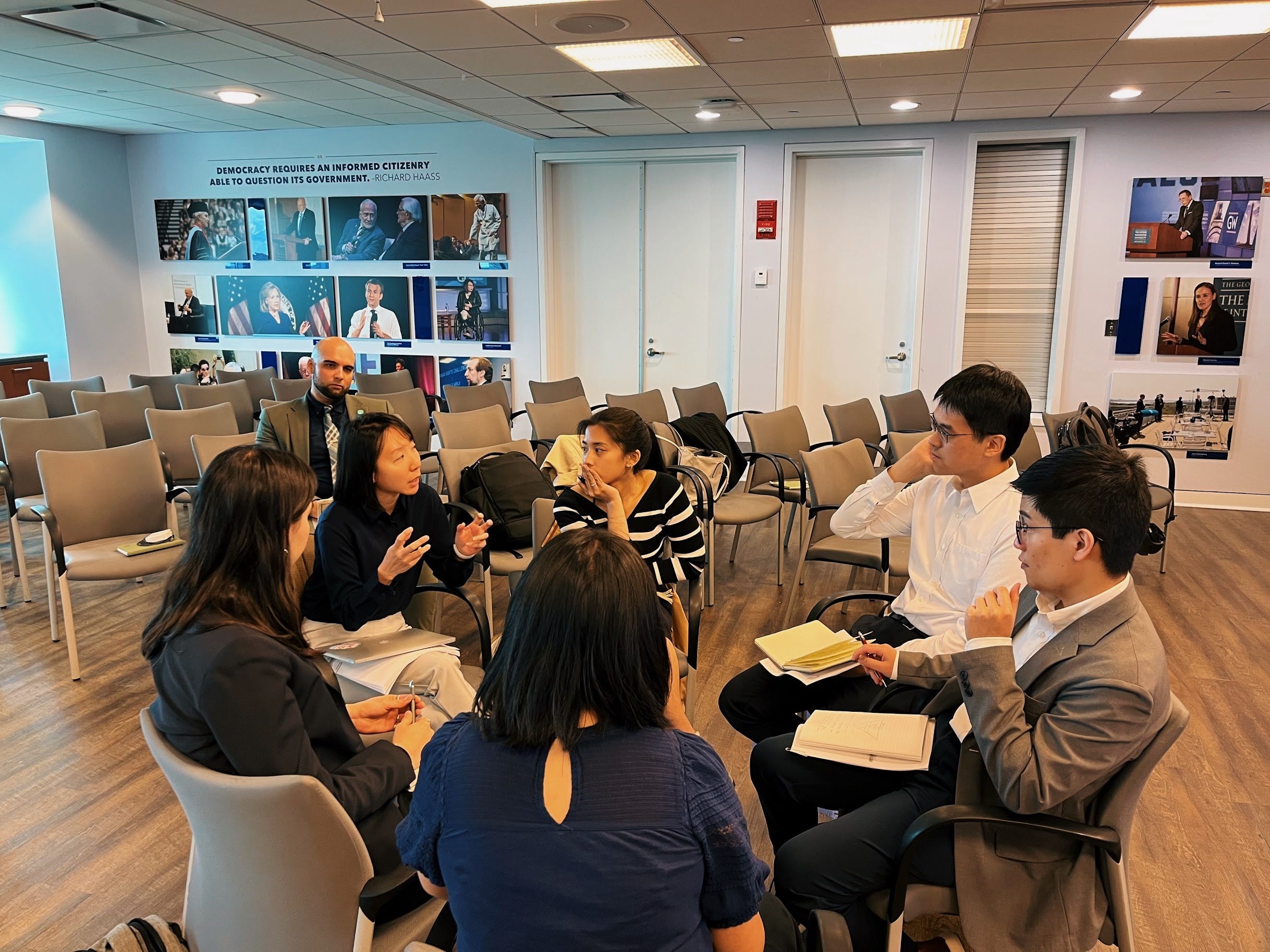
2 - Storytelling has the power to shape perception, but dialogue has the power to shift presence. And though 1:1 human relationships will never be an alternative to the dangerous asymmetry of geopolitics, they can still be a modality for harm reduction. I have read exhaustively of the talking points Chinese nationalists use to justify annexation of (“reunification with”) Taiwan. Hearing this rhetoric at Strait Talk from the Chinese delegation in person, in good faith, did not make it more morally sound or politically reasonable. But it did make their logic more legible, more human. And once I could see the shape of that logic, I could contain it—intellectually and emotionally.
I was not persuaded from my original ideology — that Taiwan has never belonged to the People’s Republic of China, that annexation would not solve their internal cultural and social problems — but I felt more grounded. The world outside us and the conflict between our nations remain the same, but ✨something has changed within me ✨. I had chosen to listen with compassion, and was still left with my convictions. I did not have to deny their humanity to keep mine.
In a world where state powers often benefit from keeping people like us diametrically opposed, our dialogue can be a triumphant act of refusal. If the state declares us fundamentally incompatible, then speaking to one another—especially across lines of nationalism or historical trauma—is itself a subversive act. Even if we never cease to disagree, choosing dialogue disrupts the forces that would rather we remain strangers or enemies.
In another full-circle moment, some of our conversations even expanded upon my summer camp musings from Volume 05 to think more expansively about how heritage-based camps can become peace-building projects. I’ve written before about how these spaces can reinforce particular collective memories to affirm identity, often anchoring that identity in a fixed relationship to historical trauma. But I’m increasingly interested in how these same spaces can also be sites of reconciliation, where identity becomes more expansive and less bound by inherited antagonism.
Take, for example, youth peace camps that bring together Israeli and Palestinian teenagers. While some summer programs have historically linked Jewish identity and healing to Zionism, there are others that deliberately and radically resist this framework. In these peace camps, youth from both sides are invited to share stories, histories, and grief in person. These encounters complicate the collective memories each group has inherited—memories that, left unchallenged, might otherwise compel them toward fear, resentment, or even violence later in life. The camps don’t erase political differences, but they create space for mutual recognition, radical empathy, and the possibility of something else.
At a recent senior staff retreat for the Taiwanese American Foundation summer conference, some of us shared memories of being told from a young age that we were Taiwanese, not Chinese—and how as children we had internalized that distinction not just as a factual or political one, but as a moral indictment. Being Chinese wasn’t “wrong for us”; it was wrong, something to be feared and broadly rejected. I’ve also often spoken about how the PRC’s global aggression and its mobilization of citizens/netizens as ideological enforcers have dulled my curiosity for deeper interpersonal understanding.
And yet, my Strait Talk friend Y and I have begun dreaming: of a space where Chinese and Taiwanese youth, including those in diaspora, can develop identities not constrained by a century of humiliation or state-defined narratives. An environment where healing doesn’t hinge on the annexation of Taiwan, and where recognition of shared humanity can begin early—breaking the cycles of information asymmetry and inherited enmity.
We imagine a peace camp of our own, where the stories we pass down no longer foreclose relationship, but instead open the door to transformation. My friend C wonders whether building closeness will ultimately serve the PRC’s agenda— to blur our distinctions and recast us as siblings under one nation. But I have hope that the opposite is more likely: that through genuine relationship, we will learn to truly appreciate our differences and stand up for each other’s sovereignty and right to self-determination. Someday, we may forge a solidarity that seeks not to erase what sets us apart, but to dismantle the injustices that harm us both—not as siblings by state decree, but as friends by choice.
Announcements & Events
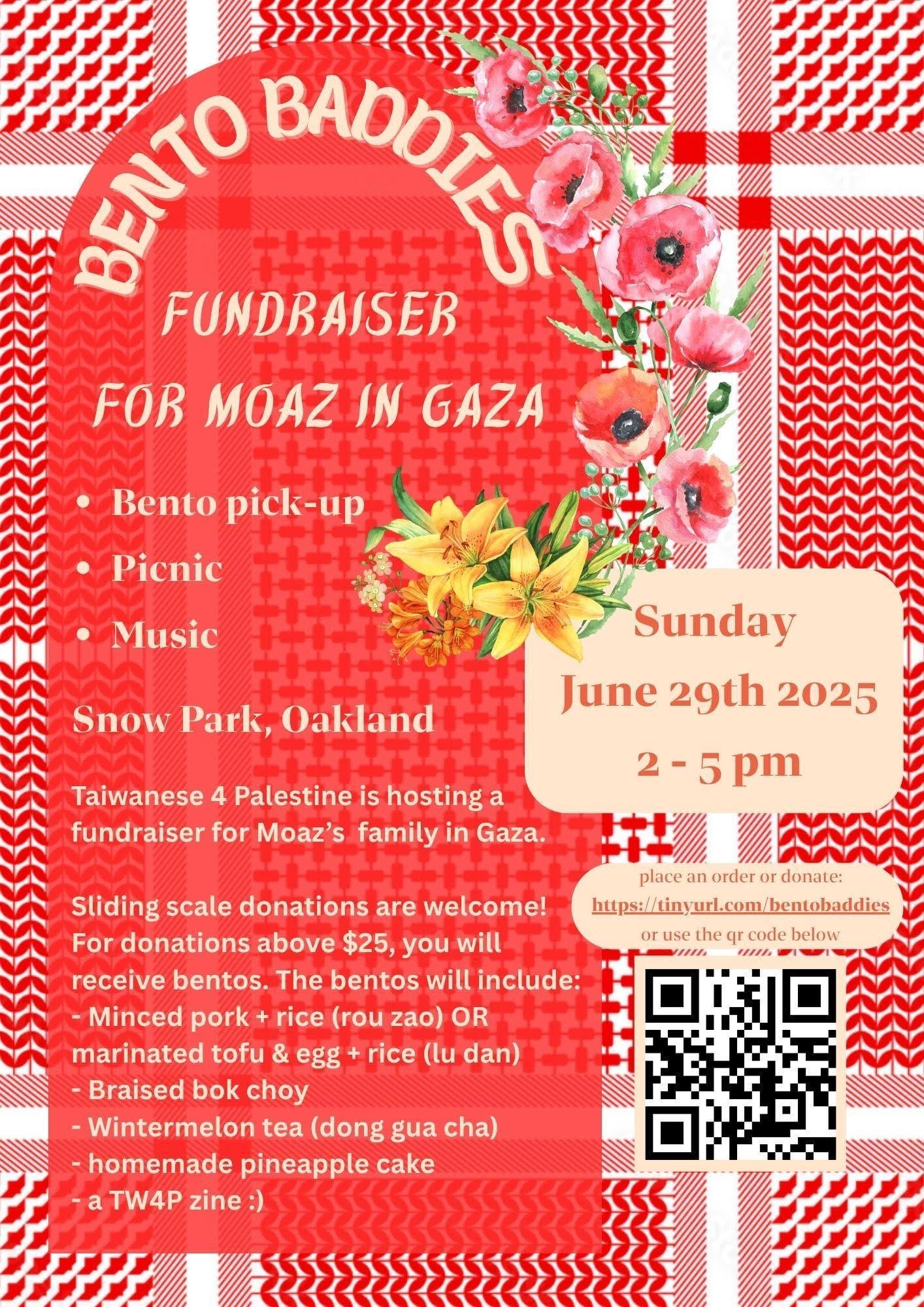
[Oakland TW4P Bento Fundraiser] Over the past year, members of Taiwanese 4 Palestine have been video calling and messaging Moaz, a Palestinian man who is in Gaza along with his family. His family is often moving and hungry, and many loved ones have passed away since the ceasefire has ended. TW4P is hosting a fundraiser to help raise money to support Moaz's family.
For donations over $25 to Moaz, we will be making 肉燥 bentos to be picked up or enjoyed at Snow Park with TW4P community! The bentos will include: (1) Taiwanese minced pork + rice (rou zao) OR marinated tofu + egg + rice, (2) Braised bok choy, (3) Wintermelon tea, (4) Homemade pineapple cake, and (5) a TW4P zine!
Donations can be sent directly to Moaz's fundraiser or Venmo'd to @kristilin. Suggested donations are $25-$100 per bento with the upper end suggested for those with class access (for example: tech workers, those with access to family wealth, those who regularly have expendable income).
Pre-order and pickup information: tinyurl.com/bentobaddies
Love another installment in the Lily series!