
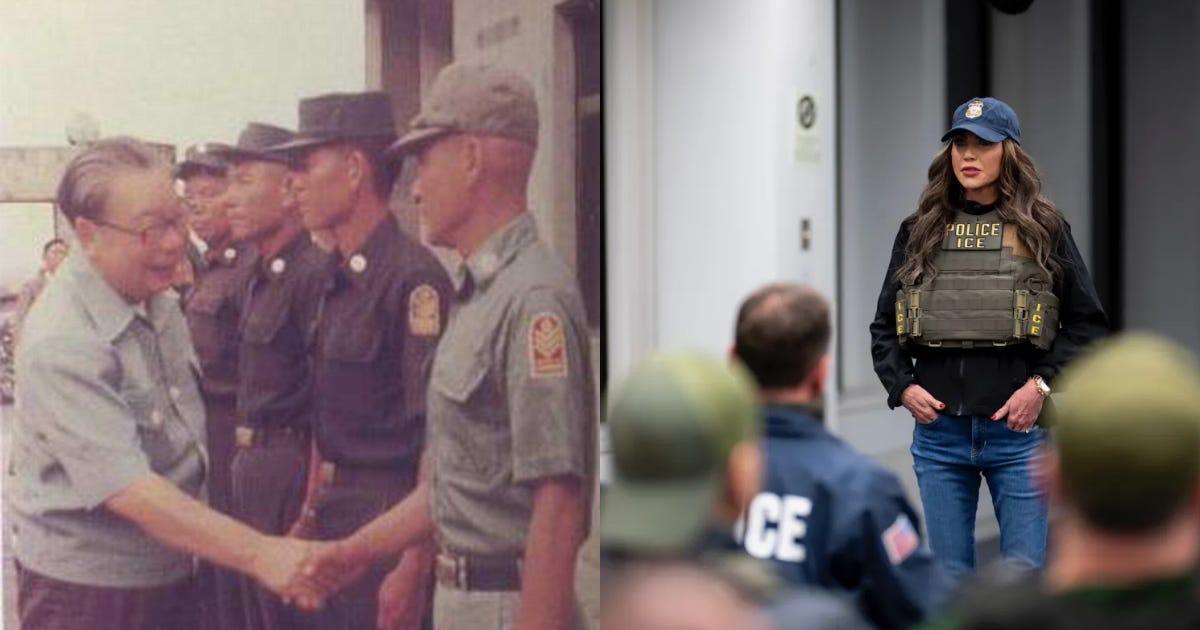
[去冰!] "Extraordinary, Emergency, Temporary"
Leona and historian Dr. Hong-Ming Liang examine parallels between Taiwan’s Martial Law–era Garrison Command and contemporary ICE. Join the conversation!


Hi study group friends!
What’s in this post:
A conversation between Dr. Liang Hong-Ming and myself exploring some cursory observations/thoughts about ICE and Taiwan’s Garrison Command (TGC), the “secret police” that enforced martial law and suppressed dissidents during White Terror (remember that you can always opt for the audio version if you prefer that to reading)
Some self-study resources, including a timely lecture series from the Memorial Foundation of 228 (delivered in Mandarin, but with decent auto-generated English subtitles on YouTube if needed). Ranging from 12-60+ minutes
An invitation to join our pondering! Share your questions, comments, and challenges — we’re figuring this out together! If privacy is a concern, feel free to email me directly to share your thoughts
The following conversation with Professor Liang Hong-Ming (@taiwanworldhistory) grows out of our shared, ongoing effort to think through possible connections between ICE in the United States and the Garrison Command of Taiwan’s Martial Law Era. Much of this draws on Dr. Liang’s expertise as a Minnesota-based Taiwanese American historian, but we’re both working through intense speculation and observation in real time! Our intention is not to draft a thesis, but to publicly examine patterns in history and current events and incorporate your input as we do so together.
We hope you’ll join the conversation by commenting below (questions, reflections, challenges) as we collectively wrestle towards more clarity and principled change in our communities. More to come, but here’s a start.
Leona: Hi Dr. Liang! Can you tell us a bit about your background?
HM: My academic training is in modern Chinese history, 1900-1949— specifically, the manufacturing of modern Chinese identity under the Nanjing KMT. My teaching and research interests expanded to World History, Global Studies, democratic consolidation (and now, sadly, populism and democratic decline). When I was in graduate school in the 1990s, Taiwan Studies barely existed in the North America/English language world, and as you know, was still politically taboo in Taiwan. I don’t want to mislead about my training and expertise. I left Taiwan at a young age in 1978, and I think that motivated a life-long, near-obsessive, focus on trying to read, learn, understand, and think about Taiwan and its history.
Leona: I love that so much. I’m not a historian at all, so you’re already adding much-needed expertise to the discussion. And I appreciate how accessible you’ve made your research and writing!
HM: The scholarly landscape for the study of Taiwan has changed in amazing ways in these few decades— when I started at UW-Madison as an undergraduate in the 1980s, my parents in Taiwan still wrote to remind me to keep my Taiwan politics opinion to myself.
Leona: We’ve connected a bit through our individual Substacks, but you also expressed interest in talking through, from a historian’s perspective, some of the visceral connections we might be making between ICE and the Taiwan Garrison Command, which I’ve generally understood to be the secret police force during Chiang Kai-shek and, later, Chiang Ching-kuo’s martial law. They were the agents ultimately arresting and disappearing suspected dissidents and communists.
HM: It seems to me that Taiwan Garrison Command (TGC) and ICE share more similarities at the top-line, ideological level -- and as with many historical comparisons, the deeper we dig into the particulars, the more differences appear. Fundamentally, both serve as instruments of political control and intimidation for a paranoid, autocratic entity/mindset.
Leona: That was my gut reaction, too— I was struck by the way they both operate specifically to incentivize compliance and deference.
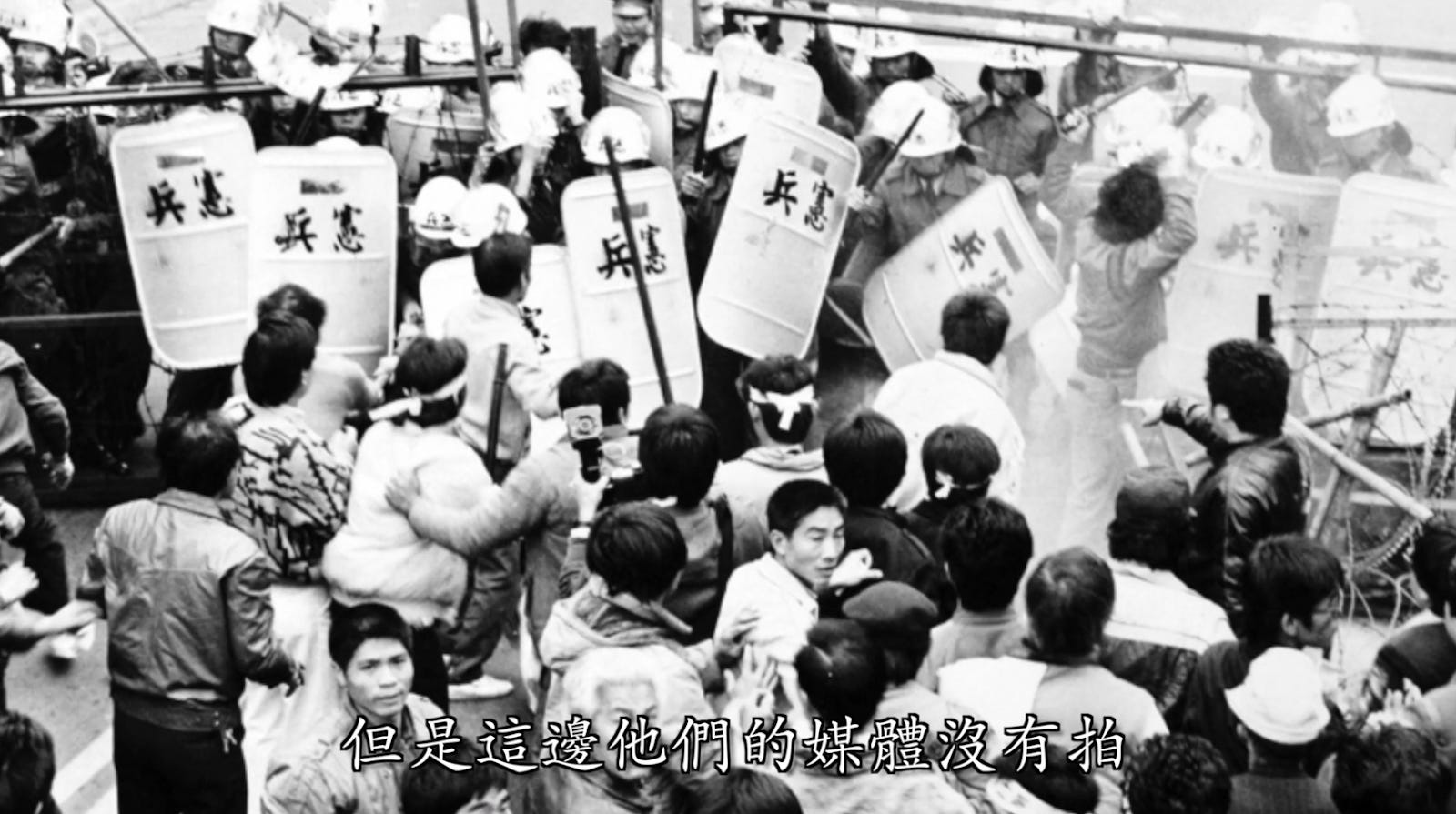
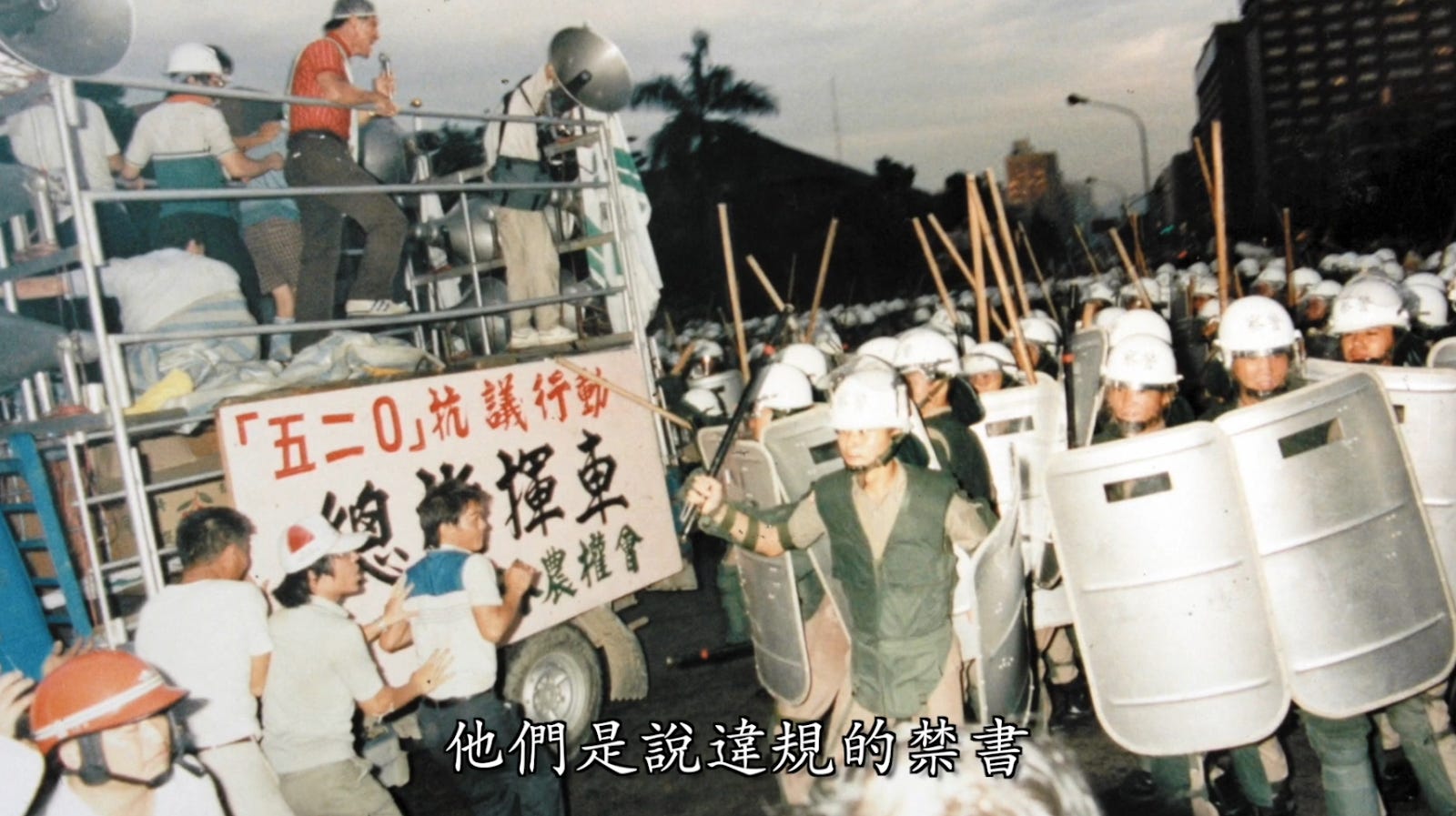
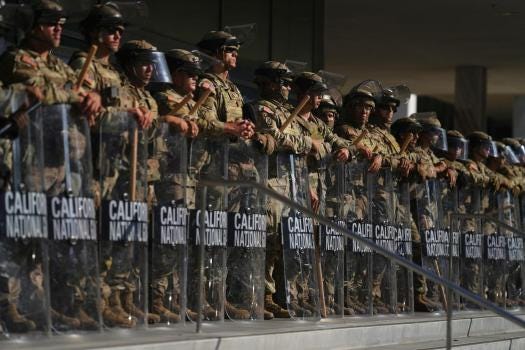
HM: I started getting alarmed right after 9-11 when the Patriot Act and the rush to form Homeland Security reminded me a lot of the feelings and aesthetics of childhood Martial Law in Taiwan. For Taiwan it was Temporary Provisions against the Communist Rebellion [動員戡亂] and Martial Law [戒嚴]. I think the sense of being under siege, panic, extraordinary measures, fear ran from the oddly named Patriot Act, Global War on Terror, DHS/ICE, all the way to 2026 where the Trump regime obsesses over alleged immigrant crimes, domestic terrorists/Antifa, and eventually the Insurrection Act.


For those so inclined, take a look at the DHS website — what do you notice? What rhetoric strikes you? Let us know in the comments!
Leona: Right, so there are structural similarities. From what I’ve read, the Taiwan Garrison Command operated as a military-intelligence body in Taiwan’s authoritarian state, and scholars have argued that beyond functioning as a tool for Kuomintang domination and repression of the Taiwanese, the Garrison Command was also central to war mobilization.
Because the KMT governed Taiwan as a wartime polity, they effectively used the logic and urgency of national survival to shape everyday governance. So all of their tactics: surveillance, coercion (arrests, expedited trials), extraction… all of these practices were justified under the auspices of preparation for war, homeland “reclamation,” and defense against the communist threat.
And to your point, the Department of Homeland Security was created after the 9/11 attacks, centralizing various arms of the national security bureaucracy to oversee counterterrorism, immigration enforcement, and border security. From its inception, the DHS has been widely criticized for its structural flaws, for “fusing reams of disparate and unreliable information to conduct risk assessments… without a documented track record of providing security benefits.”
None of this is new; what we see under the Trump administration builds upon and intensifies existing surveillance and enforcement machinations, deploying them more forcefully towards so-called “domestic” terrorists, including “anti-ICE protesters and anyone who allegedly funds them.” The parallel justification for DHS/ICE has thus been immigration enforcement as a component of homeland protection and counterterrorism.
What I’m trying to relate is how both systems have effectively expanded their reach on the basis of existential threats (communism in Taiwan; terrorism in the United States), giving them sweeping authority over surveillance, policing, and incarceration, even as the definitions and boundaries of those threats have become precariously destabilized, poorly defined, and unsubstantiated.
There are contextual differences we should name, though.
HM: Obviously, in the case of Taiwan, it went from non-democratic Japanese administration, to autocratic KMT military occupation; whereas in 2026 US is backsliding from a functioning democracy into some version of modern autocratic rule – perhaps what some have proposed as “electoral autocracy.”
In both cases, the pretense was extraordinary, emergency, and temporary. Chiang Kai-shek suspended the 1946 constitution; he did not dare to abolish it; I can see the US suspend the US Constitution (in some ways, amendments have already been functionally suspended) on the same premise of emergency, provisional, extraordinary existential threat (Chinese communists, immigrants, insurrection ....) This is why I am skeptical that a free and fair midterm election will be allowed this year.
These are just preliminary, roughly sketched out ideas. More to ponder, read about, and refine.
Leona: What other connections resonate with you?
HM: TGC and ICE are interesting to me in the ideological context of emergency/temporary/extraordinary, real or engineered -- both are neither military nor police -- paramilitary, almost like a mini-security-state unto itself. ICE has the foot soldiers, the special forces, the intelligence units, the cyber warfare units, the propaganda information warfare, the concentration-detention camps, similar to how broad TGC’s departments were. And unlike how an ordinary part of the government might run, one gets the feeling ICE 2026 is being directly commanded out of the White House; similarly if my memory is correct, TGC was under de facto control of CCK, Chiang Kai-shek’s son.
Leona: If the similarities feel apparent to us as Taiwanese Americans… What do you think is shaping the perception of those who are more rooted, emotionally or physically, in Taiwan? Are there specifically “American” dynamics to ICE that aren’t as legible?
HM: While fear, intimidation, and violence are similar, it seems to me ICE and TGC differ significantly on race and migrants/outsiders/the other (for now). The animating force of the US since its founding has always been white racial entitlement and white racial panic -- two sides of the same coin. I’ve always found it fascinating to hear echoes of white privilege in the US with similar arrogance/entitlement from what Taiwanese sarcastically call 天龍人 -- and similarities in the populism of the KMT’s Han Kuo-yu campaign and the MAGA Movement (especially the aesthetics: color-clashing clothing, hats, flags, nostalgia for a utopian “past” ....).
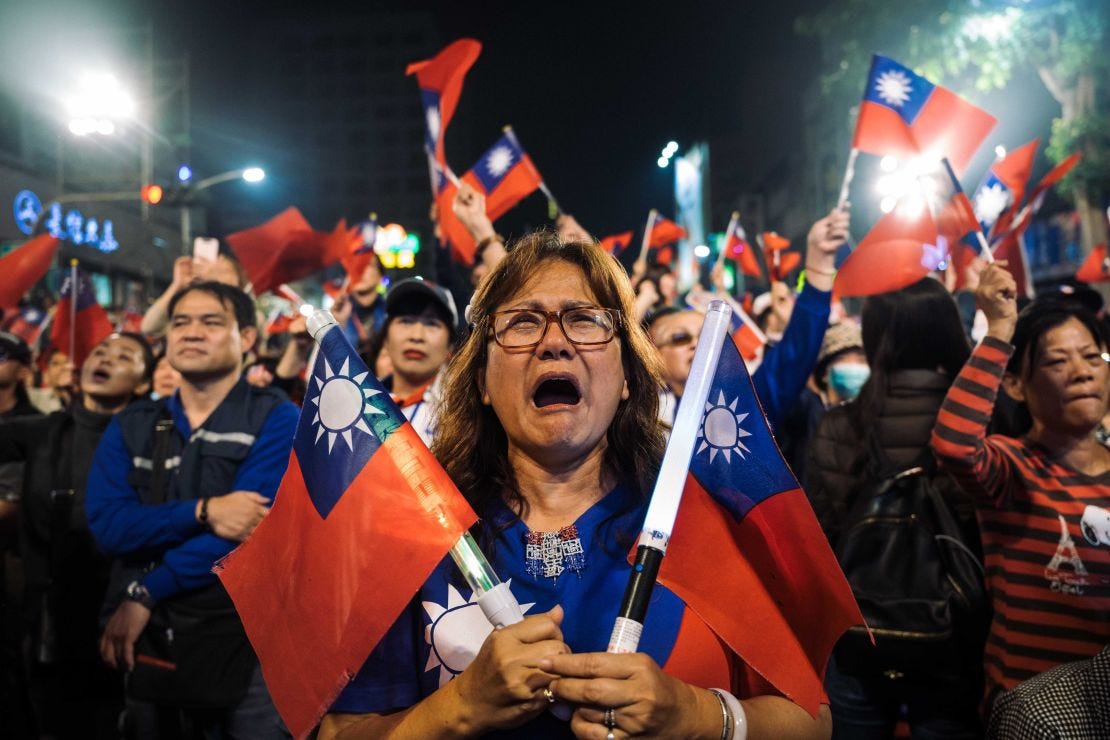
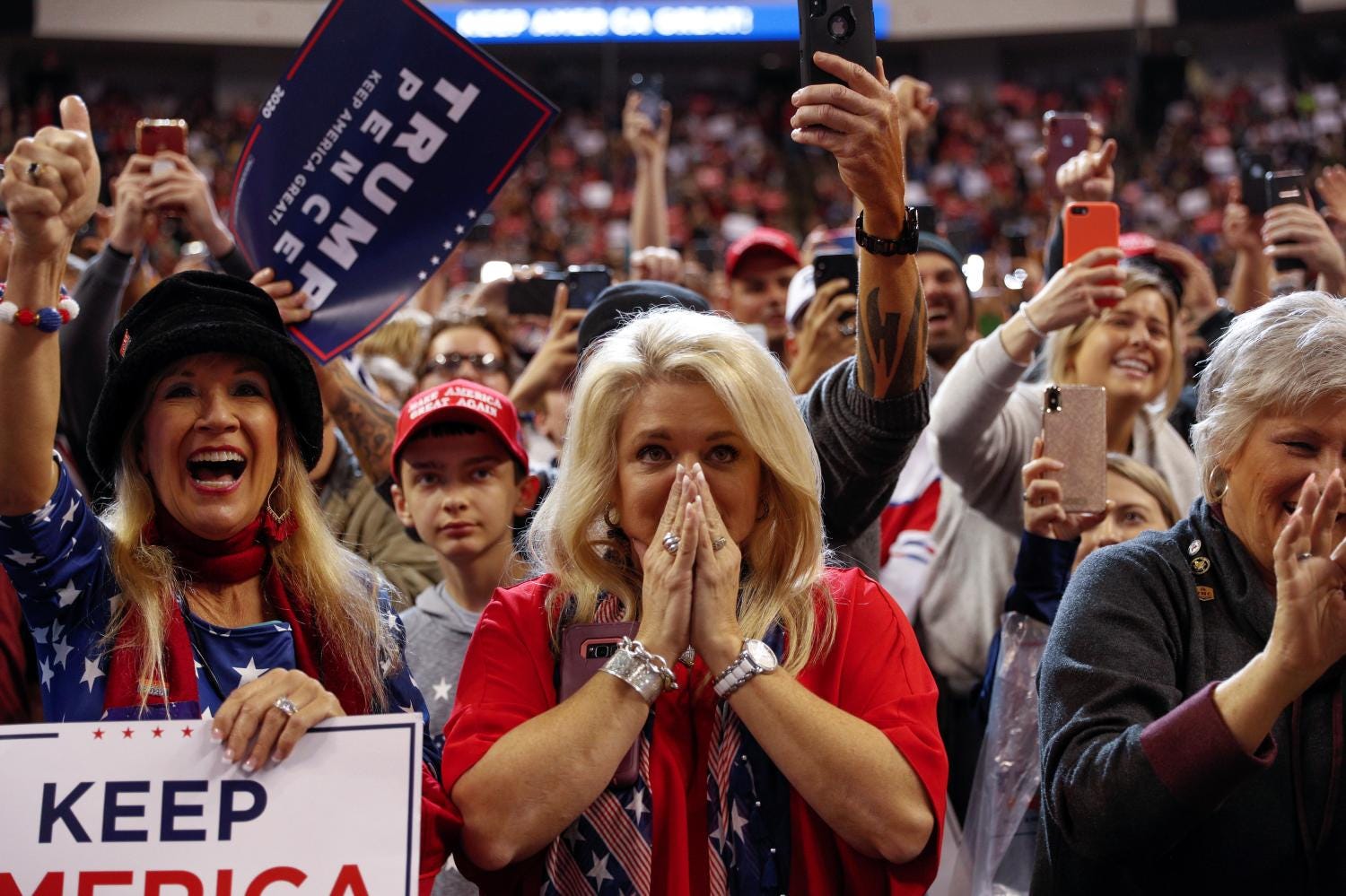
But I think the KMT, even when they retreated to Taiwan, was focused on pacifying the local Taiwanese and mostly worried about fellow Chinese who were communist collaborators, whereas ICE (for now) is primarily focused on removing humans they consider foreign/alien/incapable of becoming “real” Americans.
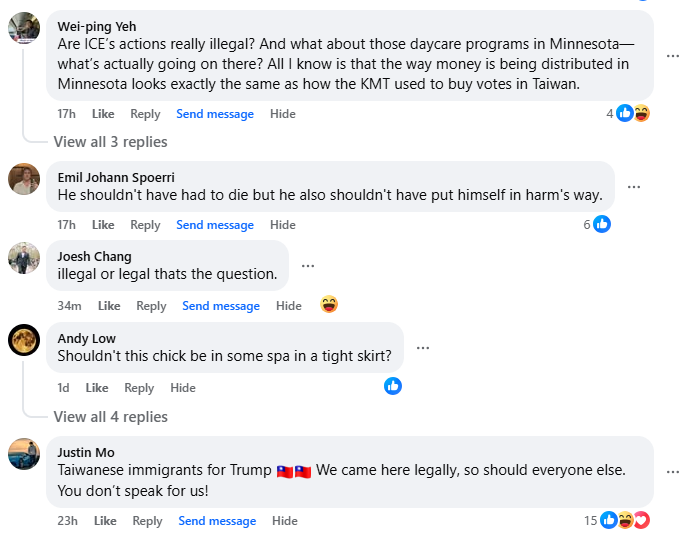
Leona: I’m trying to understand how so many Taiwanese people, especially lately, have come to align themselves with ICE. There’s a deep dissonance I’m struggling with, particularly among those who were themselves oppressed under the KMT. I would have expected a sharper sensitivity to patterns of unchecked or extrajudicial enforcement, but instead I’ve heard a prevailing view that the violence is justified: either because protesters are seen as antagonistic, or because there are moral objections to the humanity or legitimacy of “illegal immigrants.” I don’t quite know how to name these stances without sounding judgmental, but I feel genuinely heartbroken that this framing has become a dominant position. It may not be rational or “permissible,” but… can we at least try to understand the emotional logic here?
(Note: my friend David and I are working on another Q&A specifically addressing the Taiwanese American “Green to MAGA” pipeline! It’s bizarre and devastating and important to scrutinize!)
HM: Historians obsess about timeline: I would guess, given a deeper dive of later period TGC, after the White Terror of the 1950s and 1960s, and more in the “being kicked out of the UN; Chiang Kai-shek aging and dying” 1970s, came closer to what we are seeing with the evolving DHS/ICE in 2026.
For the 1970s KMT, the fear was that Taiwanese enfranchisement would threaten their permanent minority occupation.
For the 2026 ICE, and we have been seeing hints of this, they have pivoted from “illegal” immigrants to “domestic terrorists” -- in words that are eerily similar to how Taiwanese independence activists were described by the KMT in the 1970s and 1980s.
Leona: Yes! That was another thing I was struck by— how we categorize people in order to obfuscate our (lack of) rationale for harming or incarcerating them. And how emotionally powerful those categorizations are. Like, once you call someone a terrorist, you absolve everyone else from any curiosity about who they are or what they believe in. They just become an enemy.
HM: By the time I was old enough to have memories in the 1970s, TGC was the riot control police used to defend the dictatorship and crush pro-democracy demonstrators— in that sense, similar to ICE now. Although, and this is not an endorsement of the KMT, CCK’s dictatorship went out of its way to pipe sob stories about law-abiding riot control police and how Taiwan independence 暴民 were violent; whereas ICE is far more gleeful at accentuating their own violence.
Leona: Though the DHS does use similar rhetoric to rationalize their violence, especially when the recent deaths— especially of white U.S. citizens— has made them deeply unpopular. These shifts could suggest an acknowledgment that violence against Black, Brown, Indigenous, or migrant communities is often treated as politically tolerable, while violence against white citizens requires additional justification and a very intentional narrative strategy. I hate saying that because it’s deplorable! But it feels like a plausible read of this situation.
HM: That’s true. In the case of the 2026 US, the broader narrative from DHS started breaking apart when the unfortunate violence touched white US citizens. One thing I am very proud of as a Minnesota resident is, warts and all, the state’s heritage of good governance, decency, and mutual aid. So I don’t want to inadvertently aid in DHS’s efforts at dividing Minnesotans. But I think it is accurate to say that once US citizens who are not so-called minorities, with names and faces, became victims of DHS’s violence, the national media’s narrative changed noticeably. Like all complex, multifaceted events, this is but one facet of course.
It is not unusual for autocratic regimes to rely on dividing the population as a tool. A hallmark of the KMT dictatorship in Taiwan was its efforts to infiltrate and control different realms of Taiwanese society and to atomize/separate. Divide and conquer. To break down the autonomous civil society/NGOs that existed in Taiwan. To create a sense within the population that resistance was too costly, and also that “other Taiwanese groups” may benefit if they chose resistance. To paint the Taiwanese independence activists as violent and foreign-paid conspirators, both of which have echoes in the 2026 US.
Returning to your point, both the KMT and DHS prefer to have protesters/activists without names and faces – humans are storytellers, and as much as I love data and statistics and world history, we are moved by narrative arcs and protagonists. This is why authoritarian propaganda prefers scary, shadowy, broad-stroke emotive categories instead of names and faces with life stories. Interesting to think about, 暴民 v. 陳菊, “immigrant crimes” v. little five-year-old Liam Ramos, and the information warfare landscape is favored by the authoritarians.
Leona: There’s so much more we can and will discuss from here! But let’s take a quick break for our study group to digest these cursory explorations.
For those reading along, please leave your reflections and questions in the comments for Dr. Liang and me to investigate and discuss further! I’m so grateful to be learning alongside you all and hope you find this line of questioning helpful.
Suggested Self-Study Resources:
The 228 Memorial Foundation Online Lecture Series - delivered in Mandarin, but YouTube’s auto-generated English translations are quite helpful!
In particular, Professor Lee’s lecture on the Cognitive Warfare of 228 illuminates the narrative control and disinformation used to rationalize widespread suppression through the Garrison Command and military police. His analysis connects the cognitive tactics used during the 228 incident to the PRC’s current threat to Taiwan’s democracy and way of life; I found a similar compelling connection to current events in the United States; namely:
[30:30] How governor Chen Yi suppressed dissent and used its control over media and communication channels to spread propaganda; the use of official channels and media to spread a government narrative reduced public access to dissent, destabilizing a “source of truth” for what was happening
For its part, the Minnesota government has had to issue several press releases specifically countering false claims repeatedly made by the Department of Homeland Security regarding their cooperation with ICE
Minnesota’s own state investigators were denied access to evidence from the ICE shootings; in response, Governor Walz told reporters that “it feels very difficult that we will get a fair outcome [of the investigation]... because people in power have already… stood and told you things that are verifiably false, verifiably inaccurate.”
[35:00] How the rhetoric of Chinese nationalism was used to incite violence against the people of Taiwan, accusing them of being traitors and Japanese collaborators even where the evidence did not support this claim.
From NPR -- The Trump administration has made repeated claims justifying the shootings of Renee Macklin Good and Alex Pretti by claiming they were carrying out acts of domestic terrorism. “They made these claims without waiting for investigations to unfold, and in spite of conflicting video evidence and witness accounts.”
“There are armed masked men in the streets acting as paramilitary agents of the state being directed to grab people up on behalf of false claims, and the government is lying about what happens before, during and afterward,” said Brendan Nyhan, a professor at Dartmouth College who studies political misinformation and misperceptions.
From The Taiwan Gazette: translated testimonials from survivors and their relatives of the 228 Massacre— “Forced Into A Car, Never to Return”
From Mother Jones: “DHS Shot Her and Called Her a ‘Terrorist.’ New Videos Show Something Different.”
 | A guest post by
|